
Shelly's Zanzibar Adventures
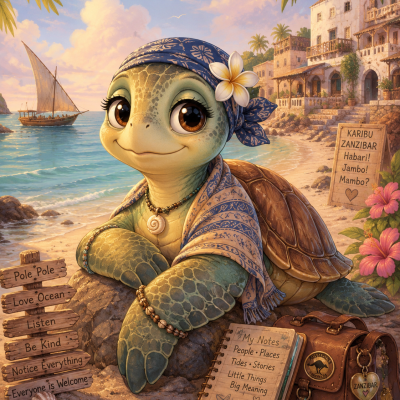
Welcome to Shelly’s Zanzibar Adventures, a heartwarming story about courage, curiosity, and starting over.
When Shelly, an Australian sea turtle, falls in love with Zanzibar, she faces a life-changing decision: stay with what she knows or take a chance on a brand-new future. Follow her journey as she navigates friendship, adventure, culture, business, and the search for a place that truly feels like home.
Because sometimes the biggest adventures begin with a single question:
What if it works?
Episode 1: The Idea That Wouldn't Go Away
1776 words, 8 min read.
I knew I was in trouble the moment I found myself standing in the fruit aisle arguing with a mango.
Not out loud, thankfully. At least I don’t think it was out loud. By that stage I had been home from East Africa for nearly a month, and I was still discovering new and unexpected ways that Zanzibar had lodged itself inside my head. The mango itself wasn’t particularly remarkable. It was reasonably large, mostly yellow, and carried a price tag that suggested it thought rather highly of itself. Under normal circumstances I would have dropped it into my trolley and continued with my shopping. Instead, I stood there turning it slowly in my hands, studying it as though I had somehow become Australia’s leading authority on tropical fruit.
The problem wasn’t the mango.
The problem was that only a few weeks earlier I had been standing beside a roadside fruit stall in Zanzibar while a smiling vendor insisted I sample three different varieties before making a decision. The fruit had been warm from the sun, impossibly sweet, and so juicy that eating it without making a complete mess of yourself was practically impossible. Around me, people had been chatting, laughing and bargaining in a mixture of languages I couldn’t always follow but somehow enjoyed listening to anyway. The air had smelled of spices and salt, and beyond the buildings I could hear the distant sound of the ocean. Compared to that memory, the mango in my hand looked as though it had been designed by a committee.
I put it back on the shelf and continued shopping, but the moment stayed with me long after I left the supermarket. The truth was that the mango had simply become the latest victim of a habit I had developed since returning home. Everything seemed to be measured against Zanzibar. A cup of tea would remind me of a café in Stone Town. A sunset would send my mind drifting back to evenings spent watching the sky melt into the Indian Ocean. Even ordinary conversations sometimes triggered memories of people I had met during my travels—people whose names I occasionally struggled to remember but whose kindness I had not forgotten.
I had travelled before. Plenty of times. I had visited beautiful places, fallen in love with landscapes, and returned home with enough photographs to bore friends and relatives for months. Usually, after a week or two, life settled back into its normal rhythm. The memories remained, but they quietly took their place alongside everything else. Travel became something to look back on fondly while planning whatever came next.
This time was different.
The unsettling part wasn’t that I missed Zanzibar. Missing a place after visiting it would have been perfectly normal. What bothered me was the feeling that part of me had never properly left. I was back in Australia. I was sleeping in my own bed, driving familiar roads, shopping in familiar supermarkets and returning to familiar routines. Everything around me was exactly where I had left it. Yet there was a persistent feeling that something no longer fit together quite the way it used to.
Nothing was wrong, exactly. My life hadn’t fallen apart while I was away. My friends were still here. My work was still here. The responsibilities I had temporarily escaped were patiently waiting for my return and seemed delighted to resume their positions. On paper, everything was exactly as it should have been.
And yet, underneath all that normality, I carried a strange sense of restlessness that refused to settle.
For weeks I tried to ignore it. I unpacked my suitcase, washed clothes, answered emails, returned phone calls and worked through the ever-growing list of tasks that accumulates whenever you disappear overseas for an extended period. Outwardly, I slipped back into my routine with reasonable success. Inwardly, however, my thoughts kept wandering thousands of kilometres away.
I found myself opening maps for no reason. Reading articles about Zanzibar’s history. Looking up information about visas and residency requirements despite having absolutely no practical need for that information. Every time I caught myself doing it, I came up with a perfectly sensible explanation. I was curious. I enjoyed learning. I liked understanding how places worked.
The problem was that curiosity had always been one of my favourite disguises.
By Friday afternoon, after accomplishing remarkably little despite spending most of the day sitting in front of my computer, I finally admitted defeat. The cursor blinked patiently in the middle of an unfinished document while I stared back at it, neither of us making any meaningful progress. Outside, the weather was beautiful. Sunshine streamed through the window and somewhere in the distance I could hear children playing. The world appeared determined to enjoy itself while I sat indoors wrestling with thoughts I didn’t particularly want to examine.
Eventually I closed the laptop, grabbed my notebook and headed for the beach.
Whenever life became too loud, I needed ocean time.
Most people assumed that phrase meant relaxation. It didn’t. Ocean time wasn’t a holiday and it certainly wasn’t laziness. Ocean time was what happened when I needed enough quiet to hear myself think. The ocean had always been my favourite place for that. It never interrupted. It never offered advice. It never suggested productivity hacks or personal development strategies. It simply existed, vast and patient, making my problems feel small enough to examine without being overwhelmed by them.
The beach was exactly as I hoped it would be when I arrived. A few people wandered along the shoreline. Children splashed in the shallows while their parents watched from a safe distance. An older couple sat beneath a tree sharing what looked suspiciously like a picnic. The scene felt peaceful without feeling lonely, alive without feeling crowded. It was the sort of place that allowed you to disappear into your own thoughts while still feeling connected to the world around you.
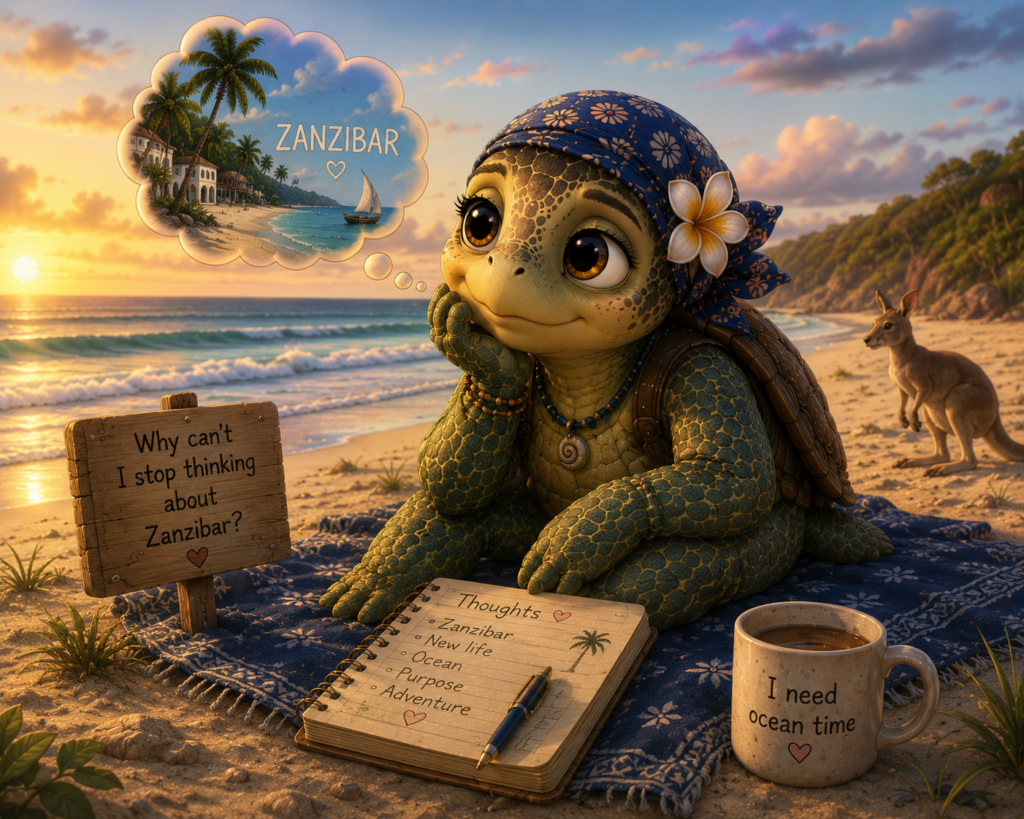
I slipped off my shoes and settled onto the sand. For a long time I simply watched the waves. They rolled towards the shore in endless succession, each one collapsing into white foam before retreating and making way for the next. There was something comforting about that rhythm. The ocean never seemed rushed. It never worried about tomorrow. It simply continued being itself.
Gradually, the noise inside my head began to quieten.
That was usually how ocean time worked. The answers rarely arrived first. Before answers came silence, and before silence came the willingness to stop running from whatever question was demanding attention.
The question waiting for me that afternoon had been following me for weeks.
I knew it. I simply wasn’t ready to admit it.
I opened my notebook and rested it on my lap. A warm breeze drifted across the beach, carrying the smell of salt water and seaweed. Somewhere behind me somebody laughed. A gull landed nearby and regarded me with the sort of expression that suggested it doubted my decision-making abilities.
Honestly, it may have had a point. The notebook remained open. The page remained blank.
And almost immediately, I found myself thinking about Mandy.
That happened often these days. Certain memories arrive unexpectedly, slipping into your thoughts so naturally that for a moment it feels as though the person is still sitting beside you. Mandy had always possessed an extraordinary ability to identify nonsense, particularly my nonsense. She could cut through weeks of overthinking with a single question and a raised eyebrow. It was one of the reasons we had become such good friends. It was also one of the reasons she could be incredibly annoying when she was right.
I knew exactly what she would have asked if she had been sitting beside me on the beach.
“So what’s really going on?” The answer came immediately. Nothing.
The imaginary version of Mandy rolled her eyes. “That’s a lie.”
I smiled despite myself. The conversation continued exactly as I knew it would because we had been having versions of it for years. Mandy had never been interested in the carefully edited answers people offered when they were avoiding the truth. She had an irritating talent for digging directly to the heart of things.
What aren’t you admitting?
The question settled over me as I stared out across the water. The waves continued their steady journey towards the shore. The gull wandered off in search of someone making worse decisions than I was. Around me, the beach carried on exactly as it always had.
Inside my head, however, something finally shifted.
For weeks I had been circling around the same thought, examining it from every possible angle while pretending it wasn’t already taking root. It appeared while I was making coffee. It surfaced while I was driving. It arrived in quiet moments and busy ones. No matter how effectively I distracted myself, the thought always returned.
Slowly, I lowered my pen to the page. Then I wrote six words. What if I moved to Zanzibar? I stared at the sentence. The words looked absurd.
They also looked strangely familiar, as though they had been waiting patiently for me to catch up with them.
I read the question again. This time I noticed something surprising. For the first time in weeks, I felt relief.
Not because I had found an answer. I hadn’t. The question raised far more problems than it solved. I had no idea how such a move would work, whether it was practical, whether it was affordable or whether it was completely ridiculous. Yet simply seeing the thought written down felt different. It was no longer hiding in the shadows of my mind where it could grow larger and more intimidating with every passing day.
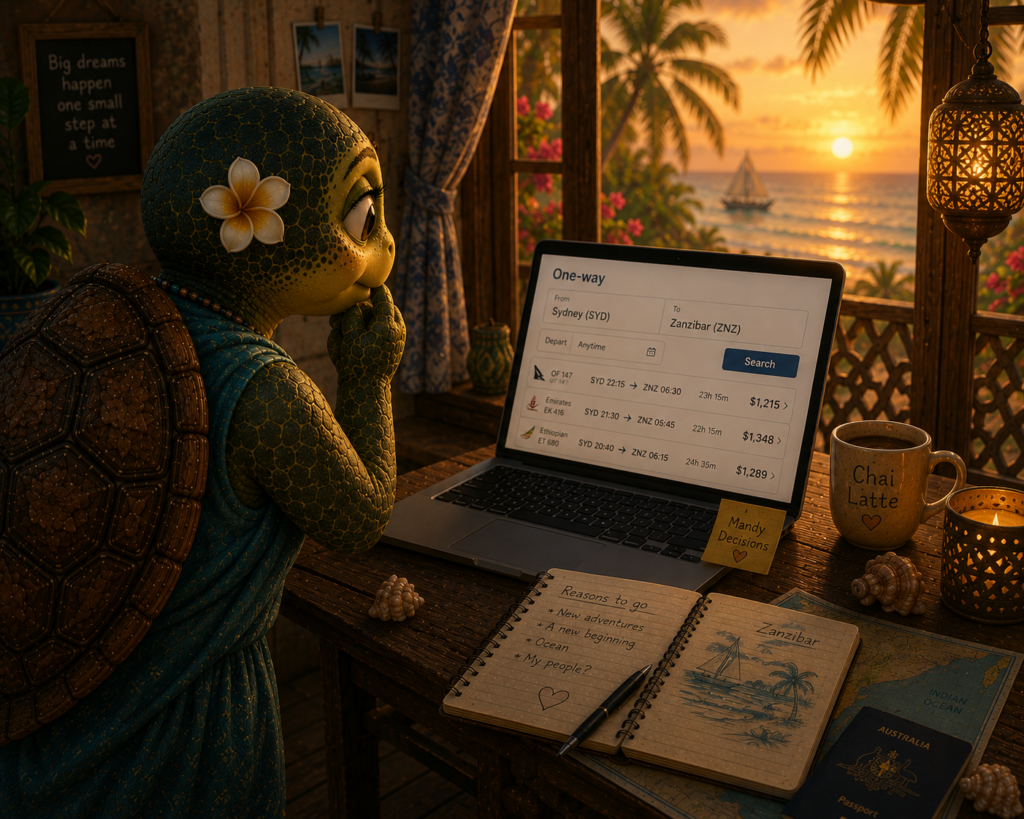
It existed now. A real question. A real possibility. A very large Mandy Decision.
I closed the notebook and looked back towards the horizon. The late afternoon sun scattered gold across the water, and the ocean stretched endlessly into the distance. For the first time since returning home, I stopped asking why Zanzibar wouldn’t leave my thoughts.
A far more important question had appeared.
What if it wasn’t supposed to?
The idea had followed me across continents, through airports, into supermarkets, onto beaches and into quiet moments when I was least expecting it. I had spent weeks trying to push it aside, explain it away and convince myself it was nothing more than post-holiday nostalgia.
Sitting there with the sound of the waves around me, I finally accepted the truth.
The idea wasn’t going away.
Sooner or later, I was going to have to answer it.