
Shelly's Zanzibar Adventures
Episode 2: Why Zanzibar?
2,200 words, 10 min read.
The question sounded simple enough.
Why Zanzibar?
Not Bali. Not Portugal. Not any of the dozens of beautiful places I had visited over the years and enjoyed enormously and then left behind without a second thought. Why this particular island, sitting in the Indian Ocean off the coast of Tanzania, with its winding medieval streets and crumbling coral-stone buildings and vendors who called out greetings in Swahili whether you understood them or not?
I had been trying to answer that question for weeks. Every time I thought I had pinned it down, the answer shifted slightly and I found myself back at the beginning, staring at the ceiling at two in the morning with the very reasonable suspicion that I was overthinking something that should have been obvious.
Eventually I gave up trying to find the answer in my ceiling and went looking for it in my photographs instead.
I had taken far too many photographs.
This was not unusual.
What was unusual was that I had spent an entire evening going through them and found myself making a sound I can only describe as involuntary longing. It was embarrassing. I was sitting alone in my kitchen with a cup of tea and a laptop, making quiet sounds of longing at holiday photographs like some kind of documentary narrator who had forgotten to maintain professional detachment.
But then, the photographs were doing something photographs rarely do.
They were making me remember exactly how it felt to be there.
Not just what things looked like.
How they felt.
I had arrived in Zanzibar in the late afternoon, which turned out to be exactly the right time.
The light was different from anything I had expected. It didn’t fall so much as it settled, laying itself gently across the whitewashed buildings of Stone Town in shades of amber and gold that seemed too deliberate to be accidental, as though the island had arranged the sunset specifically for the benefit of new arrivals who needed convincing.
I was already convinced within ten minutes.
The streets of Stone Town were unlike any streets I had walked before. They were narrow in the way that suggested they had never been designed for the modern world and had absolutely no intention of apologising for it. Buildings rose on either side, close enough that neighbours on opposite sides of the lane could presumably conduct entire conversations without raising their voices. Doors — the famous carved wooden doors of Zanzibar, each one an intricate piece of craftsmanship that seemed almost too grand for the buildings surrounding them — stood open in the heat of the evening. Through some of them I could glimpse courtyards and staircases. Through others came the smell of cooking and the sound of lives being lived.
I had no particular destination in mind that first evening.
I simply walked.
This is, I have come to believe, the only correct way to arrive somewhere new. Not with a guidebook held at arm’s length and a list of sites to be ticked off in order of importance. Just walking. Turning wherever the street looked interesting. Stopping when something caught your attention and lingering until you were ready to move on. Getting slightly lost and discovering that being slightly lost was, in fact, the point.
Stone Town rewarded that approach generously.
I stumbled upon a tiny shop selling nothing but spices, its doorway surrounded by sacks of cloves and cardamom and dried chillies whose combined fragrance was remarkable enough to stop passing strangers in their tracks. I found a crumbling building that appeared to be simultaneously falling apart and being actively lived in, with washing strung between its upper windows and cats arranged at various points along its lower walls with the studied nonchalance that cats have perfected across all cultures. I came across a small square where a group of old men sat playing a board game I didn’t recognise and didn’t ask about, because watching was interesting enough.
The city existed on its own terms.
It had done so for centuries.
You felt that immediately. Not in a way that excluded you, but in a way that invited you to pay attention.
On my third morning I found Shangani Beach, which was either fate or geography and possibly both.
I had been walking with no particular purpose again, moving in what I vaguely believed was a westward direction, when the buildings gave way and the Indian Ocean appeared without warning, stretching away towards a horizon that looked almost too blue to be real. The beach itself was modest by Australian standards. There was no surf to speak of, no rolling waves demanding athletic performance. The water was calm and warm and a particular shade of turquoise that I was fairly certain didn’t exist in the colour charts I had grown up with.
I sat down.
I had not planned to spend two hours there.
I spent two hours there.
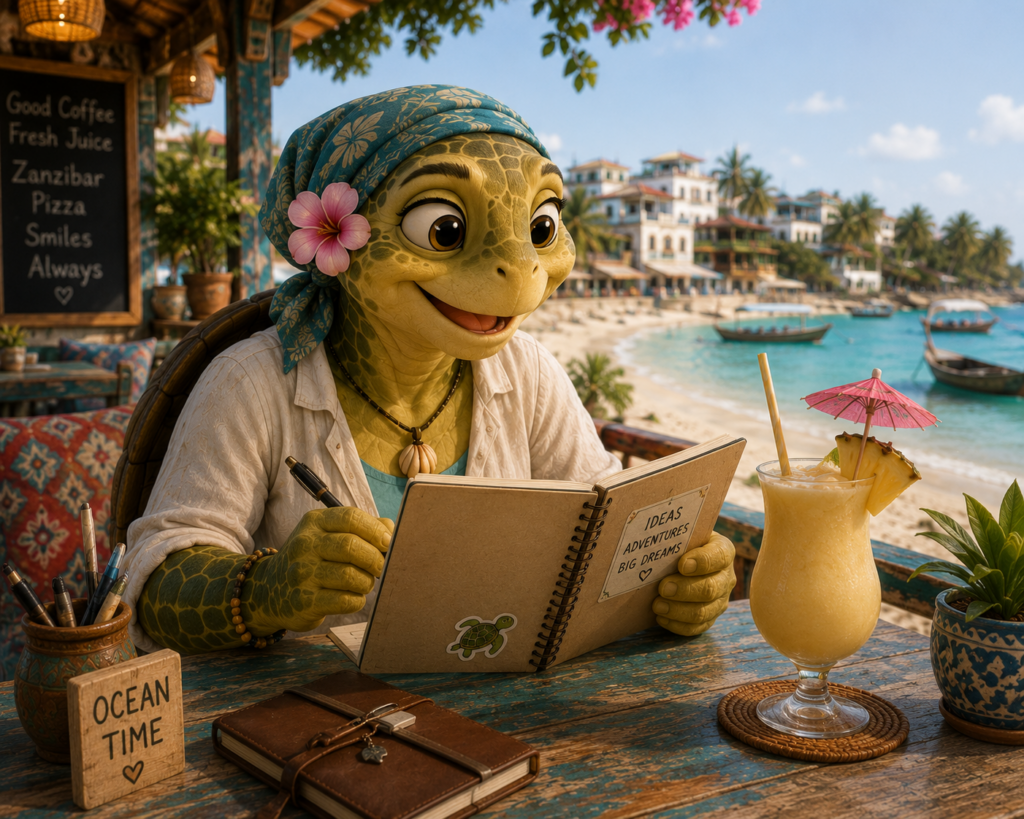
There was a rhythm to Shangani Beach that was unlike the beaches I knew at home. Fishermen moved along the shoreline in the early morning, their wooden boats bobbing gently at anchor just offshore. Children appeared from somewhere and disappeared somewhere else with the mysterious efficiency that children seem to achieve in every culture. Local people sat in the shade of trees along the waterfront, talking quietly or simply existing in the way that only people who have somewhere genuinely peaceful to be can manage.
Nobody seemed to be in a hurry. This sounds like a small thing. It wasn’t.
I had spent most of my adult life in a state of low-level hurry. Even when I wasn’t actually busy, I maintained a general attitude of business that ensured I was always somehow in transit between one obligation and the next. Sitting still felt like something that needed to be justified. Doing nothing felt like something that needed to be explained.
On Shangani Beach, doing nothing required no explanation at all.
The ocean moved. The light shifted. A dhow with a triangular sail drifted slowly across the middle distance. I watched it until it disappeared and then watched the empty water where it had been for a while longer, simply because I felt like it.
I could not remember the last time I had done something simply because I felt like it.
That was when Zanzibar first started doing something unexpected.
It started making me think.
Forodhani Gardens arrived in my photographs the way it had arrived in my actual life — as a complete and somewhat overwhelming surprise.
I had read about the night market before I went. I knew it happened. I was prepared, in theory, for an outdoor food market beside the waterfront where local vendors sold grilled seafood and Zanzibari pizza and sugar cane juice squeezed to order while the city’s residents and their visitors gathered in the warm evening air.
I was not prepared for what it actually felt like to be there.
By the time the sun went down, Forodhani Gardens had become something closer to a celebration than a market. Children chased each other between the stalls. Families spread themselves across the available seating with the relaxed authority of people who knew they belonged there. Young men leaned against the sea wall talking and laughing. Tourists like me wandered between the stalls with eyes slightly too wide and expressions that probably gave away our feelings quite transparently.
And above it all, the smell.
Grilling fish. Cardamom. Something sweet and fried that I could never quite identify but ate enthusiastically every evening regardless. The salt air coming off the ocean only a few metres away. Charcoal smoke drifting through the warm night.
I ate things I couldn’t name and pointed at things that looked interesting and somehow always ended up with more food than I had intended to order, which turned out not to be a problem at all. The vendor at the first stall I visited explained the contents of each dish with a patience and enthusiasm that suggested he genuinely wanted me to enjoy my evening. The woman at the sugar cane press handed me a glass of something so cold and sweet and utterly unlike anything I had tasted before that I immediately bought a second one.
I sat on the sea wall afterwards and watched the harbour lights reflected on the water.
The city hummed around me.
I thought: I could sit here every evening for the rest of my life.
Then I thought: where did that come from?
Then I went back for one more glass of sugar cane juice and tried not to examine the thought too closely.
The people were the part that photographs couldn’t quite capture.
They were there, of course. Faces, moments, the blur of movement caught in a frame. But photographs couldn’t capture the quality of the interactions. The way a shopkeeper would spend ten minutes telling you the history of his street when you only asked whether he knew where the nearest café was. The way strangers offered directions with such precise and detailed helpfulness that you arrived at your destination feeling vaguely guided rather than navigated. The children who said hello with the confident friendliness of people who had decided long ago that strangers were interesting.
There was a warmth to the human exchanges in Zanzibar that felt different in kind, not just in degree.
I had been to friendly places before. Many of them.
This was different.
This felt like being somewhere that was genuinely pleased you had come.
I was not naive enough to think that tourism had no complications on the island, or that every encounter was as uncomplicated as it appeared. I had read enough and talked to enough local people to understand that the relationship between a place and the people who visit it — especially those who visit in numbers and from positions of relative wealth — is rarely simple. But that awareness didn’t cancel out what I actually experienced. Both things could be true. The island had its complications and its contradictions, and it also had a human warmth that was real and unmistakable and that I kept looking for after I returned home and kept not quite finding.
The honest answer to Why Zanzibar? had nothing to do with the sunsets, though they were extraordinary.
It wasn’t the beach, or the food, or the architecture, or the fascinating layered history of a place where so many cultures had arrived and overlapped and eventually produced something entirely its own.
Those things were all part of it.
But the real answer was harder to articulate.
Zanzibar had made me feel something I had not expected to feel.
When I tried to name it, the word that kept appearing was belonging.
Which made absolutely no sense. I had been a visitor. A tourist. A woman in her fifties with a camera and a notebook and a mild difficulty with the heat, moving through a place that was not hers in any conventional meaning of the word. I had no history there. No connections. No reason whatsoever to feel at home.
And yet. There had been moments — at Shangani Beach in the early morning, wandering Stone Town in the late afternoon, sitting at Forodhani Gardens watching the harbour lights — when the persistent sense that something didn’t quite fit, the low hum of restlessness that I had carried for years without ever properly naming it, had simply gone quiet.
Not disappeared. Quiet.
The way a noise you’ve stopped noticing only becomes audible again once it stops. That silence was what I kept thinking about.
Not the photographs. Not the mangoes. The silence. I was looking at a photograph of Shangani Beach when I heard Mandy’s voice.
This was not unusual. She appeared often in quiet moments, when my thoughts settled enough for her to find a foothold. I had learned to stop apologising for it, even to myself. Grief is strange that way. It doesn’t diminish so much as it rearranges, and the people you have loved don’t entirely leave. They simply move to a different part of the conversation.
“You’re not planning a holiday,” she said. I looked at the photograph. The beach. The calm water. The dhow on the horizon. “I know,” I said. “You’re planning something else.”
“I’m not planning anything. I’m looking at photographs.”
“You’re planning,” Mandy said, with the absolute certainty she had always reserved for the moments when she was right and knew it, “and you’ve been planning since you got on the plane home. Probably before that.”
I put the laptop down and looked at the ceiling for a while. Outside, my street went about its ordinary, familiar, comfortable business. Inside my head, a beach on the other side of the world kept appearing.
“What if it doesn’t work?” I asked.
I wasn’t entirely sure whether I was asking Mandy or myself. The answer came back in her voice anyway. “What if it does?”I picked up my notebook from the table beside me.
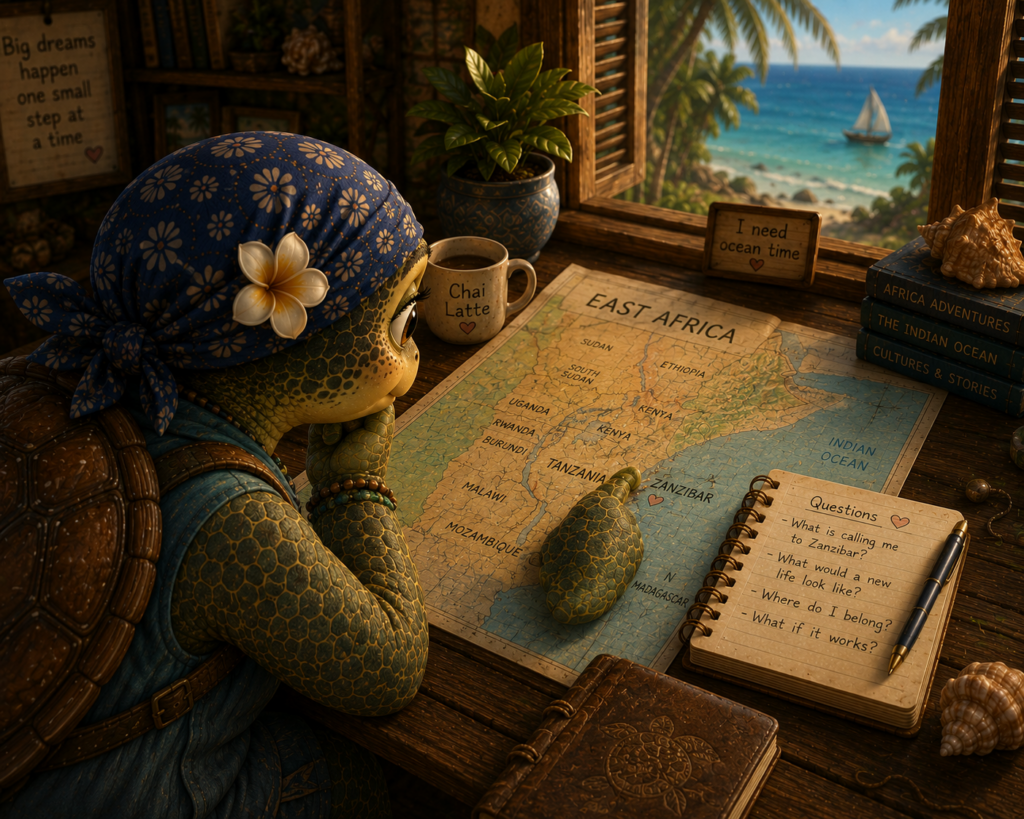
I had been carrying it around for weeks now, filling it with fragments of thoughts and questions and half-formed ideas that circled the same territory without ever quite landing anywhere.
I turned to a fresh page. For a long time I looked at it without writing anything. Then I wrote one sentence at the top of the page.
This is not about a holiday.
I stared at the words. They looked true. They looked like the beginning of something. They looked absolutely terrifying.
But underneath the fear, sitting very quietly in the way that important things sometimes do, was something else.
The word that kept appearing was possibility. And a possibility, I was beginning to understand, was not the same thing as a plan.
But it was where every plan had to start.